Nina Out and About contains affiliate links and is a member of the Amazon Services LLC Associates Program. If you make a purchase using one of these Amazon links, I may receive compensation at no extra cost to you. See my Disclosure Policy for more information.
You’re Welcome in Hawaiian & 21 Common Phrases
Are you wondering how to say you’re welcome in Hawaiian?
Do you say Aloha? Mahalo? Or something completely different?
When I travel, I always attempt to learn some basic words in the native language. Most of the time, simple phrases are enough to get around.
You obviously don’t need to know Hawaiian in Hawaii, but it can go a long way with locals if you learn basic greetings or how to say “please” and “thank you.”
So I’ve put together a list of the most popular Hawaiian words and phrases and how to pronounce them so you can practice on your next trip to Hawaii!
After reading this, you’ll be all set to enjoy the island vibes and local culture!
Need help learning a new language? I recommend iTalki! I’ve tried ALL the apps, but iTalki is the only way I’ve managed to learn as much as living in the local country.

How do You Say You’re Welcome in Hawaiian
There is no direct translation of “you are welcome” in Hawaiian, but there are multiple phrases you can choose from depending on the context.
If you want to learn the nuances of applying the different phrases, consider taking Hawaiian lessons or participating in an online group coaching call.
You can use any of the following “you’re welcome” phrases to respond to “Mahalo,” which means thank you.
Use the following phrases to create your own “You’re welcome in Hawaiian” pronunciation guide in a notebook you can take on your trip.
1. A Small Thing
When someone thanks you for doing something for them, you can say, “he mea iki.”
He mea iki is pronounced as “heh meh-ah ee-kee.”
This phrase translates to “a small thing” in English. The meaning is similar to “no sweat” or “no big deal.” The thing they are thanking you for is too trivial to need a thank you.
Suppose a server refills your drink. You would say thank you (mahalo), and the waiter might reply, “he mea iki.”
2. It’s Nothing
He mea ʻole translates to “a nothing” or “it’s nothing.” It’s pronounced as “heh meh-ah oh-leh.”
For example, if you leave a coveted beach lounge chair on a busy Hawaiian beach and someone thanks you while swooping in to snag it.
An easy way to respond is “he mea ‘ole!” while your direct meaning in English would be, “Don’t mention it. I was leaving anyway.”
3. No Problem
One of the common ways to say you’re welcome in the Hawaiian language is ʻaʻole pilikia which means “no problem.”
You pronounce ʻaʻole pilikia as “ah-oh-leh pee-lee-kee-yah.” It’s a simple and easy way to acknowledge when someone says thank you.
If you ask someone for directions to the beach, you say “mahalo” to thank them, and they would reply “a’ole pilikia.”
4 The Pleasure’s Mine
In Hawaiian, naʻu ka hauʻoli directly translates to “mine is the pleasure.”
The act of kindness brought you happiness, so there’s no need to say thanks.
You pronounce naʻu ka hauʻoli as “no-oo kuh how-oh-lee.”
If you give your tour guide a gift on your Hawaiian vacation, you reply “naʻu ka hauʻoli” after they thank you
5. It Was an Easy Thing to Do for You
Another thank you phrase is maʻalahi wale which means “just simple.”
You pronounce “maʻalahi wale” as “ma ah-lah-hee wha-leh.”
An example of when you could use this phrase is if someone sees you struggling to open the hotel door while juggling your beach bag, chair, and towel.
They open the door for you, you thank them, and they respond, “maʻalahi wale.”
How do You Say Thank You in Hawaiian
You can’t say you’re welcome if you don’t know someone is saying thank you.
There are a couple of ways to say thanks in Hawaiian.
6. Thank You
Mahalo means “thank you” in Hawaiian. A local pronounces mahalo as “mah-hah-loh.” It has a deeper meaning than simply saying thanks.
It represents your respect, honor, and gratitude towards the person.
The proper response to mahalo is either mahalo or one of the various ways of saying thank you in Hawaiian.
For example, someone gives you directions to a waterfall. You say “mahalo” to thank them, and they reply, “Mahalo, I’m glad I could help!”
7. Thank You Very Much
Every language has a different way of saying thank you, with a twist on the phrase to express even greater thanks.
Mahalo nui loa means “thank you very much,” with the “nui loa” adding the extra thanks at the end. It’s pronounced “mah-hah-loh noo-ee loh-wah.”
When you say, “Mahalo nui loa for the amazing tour,” the tour guide replies, “Mahalo nui loa,” to thank you for going on the tour.
Common Hawaiian Greetings and Phrases
If you want to pick up some words while traveling, you should try to learn more than just yes and no in different languages.
Yes and no will not get you very far in conversations.
Out of all the common Hawaiian words, these words are the most useful when traveling to Hawaii.
You’ll enjoy a more immersive trip by learning how to ask questions like “How are you?” and “Where’s the bathroom?”
Finding a Hawaiian teacher to quiz you on conversations is a great way to practice Hawaiian words and phrases.
8. Hello
Did you know Aloha means goodbye and hello in Hawaiian?
Just like mahalo, aloha has a more abstract definition that doesn’t directly translate into the English language.
Aloha is a feeling of care, affection, and connection.
You pronounce it “ah-loh-hah,” but without the loud, theatrical way the hospitality industry draws it out for tourists (“ah-LOOOH-HA!”)
When you hear “Aloha! Welcome to our beautiful paradise,” answer back with a friendly, “Aloha, I’m excited to be here!”

9. Goodbye
Aloha is also used to say goodbye in Hawaiian, but you can say a hui hou instead.
A hui hou means until we meet again, and you pronounce it as “ah hoo-ee hoh.”
In Hawaiian, you don’t want to literally say goodbye, as if you are never seeing each other again.
A hui ho is a more respectful and meaningful farewell.
As you head off to the Hawaiian airport to head back home, your friend might say, “A hui hou, safe travels!”
10. Please
You can’t know how to say thanks in Hawaiian without also being able to say please.
‘Please’ in Hawaiian is e ‘oluʻolu, pronounced as “eh oh-loo-oh-loo.”
Let’s say we were eating at Bubba Burgers restaurant in Hawaii. I say, “E ‘olu’olu pass the ketchup” for “please pass the ketchup.”
After I say “mahalo” to thank you, you reply, “he mea iki” for “you’re welcome (it’s a small thing).”
11. Welcome
How do you say welcome in Hawaiian? You say e como mai, pronounced “eh koh-moh mah-ee.”
It’s an invitation to come into a store or someone’s home.
If you arrive at a luau, locals welcome you with “e como mai,” a welcome to the celebration.
12. Upland
Upland, or ma uka (“mah oo-kah”) in Hawaiian, is a directional term for toward the mountains.
On the Hawaiian islands, everything is either toward the ocean or toward the mountains, making directions more specific and easier to understand.
Ask a local, “Which direction on the trail leads ma uka?” They respond with directions to send you up the mountain toward some amazing views.
13. Seaward
Opposite ma uka, or upland, is ma kai which is seaward. This Hawaiian word is pronounced “mah kai” and directly translates as “towards the sea.”
When navigating Hawaii, you need the ma kai direction to the beaches.
Relaxing on the shores with the perfect ocean waves is a part of your trip you won’t want to miss by getting lost.
14. No, Thank You
Mahalo means thank you, so to say “no thank you,” Hawaiians say “aʻole mahalo.” You pronounce this as “ah-oh-leh mah-hah-loh.”
It’s a good phrase to know, especially if you want to decline another drink refill politely.
For example, a server asks, “Do you want another drink,” and you reply, “A’ole mahalo.”
15. How Are You
How are you is a classic conversation starter, no matter where you are. “How are you” in Hawaiian is pehea ʻoe pronounced “peh-heh-ah oh-eh.”
You may be unable to recount your whole day in Hawaiian if someone asks you pehea ‘oe, but you can quickly respond. “I’m good,” which is maika’i ou in Hawaiian.
16. Good Vibes
Hawaiian for saying ‘good vibes’ is Maikaʻi vibes.
Maikaʻi vibes is a way to describe how good you feel soaking in the Hawaiian atmosphere. This phrase is pronounced as “my-kah-ee vahybz.”
Imagine relaxing on the beach with a positive Hawaiian attitude lifting your spirits. There is nothing but maika’i vibes on that beach.
17. The Best or Finest
To find that best maika’i vibes beach, then you want to ask for the no ka ‘oi.
Hawaiians say no ka ‘oi (pronounced as “noh kah oh-ee”) means “the best or finest.”
Even if it’s not necessary to speak Hawaiian when you travel to Hawaii, it does help to connect with the locals on a different level. Whenever I talk with locals for recommendations, I get more details and unique suggestions if I ask in their native language.
Asking a local no ka ‘oi helps you find the best beach, surfing spot, or seafood.
18. Men’s Bathroom
It’s always important to know how to find the bathroom, or lua, and figure out which one to use.
Guys are looking for the word kāne, which is Hawaiian for men.
Don’t just see a bathroom sign and rush in. Not paying attention to the words can lead to an embarrassing situation.
19. Woman’s Bathroom
Wahine, pronounced “vah-hee-neh” is Hawaiian for woman.
Ask a local for the wahine bathroom or lua wahine. Whatever you do, don’t ask for wahine lua, which means “second wife.” That’s a very different meaning, although it could be a hilarious travel story!
20. There You Have It
“There you have it” is used in Hawaii to cheer someone on or say they did a great job.
In the Hawaiian language, this phrase translates to a ‘o ia, which is pronounced as “ah-oh ee-yah.”
If you’re watching a surf competition or complementing a hula dance performer, say a ‘o ia. This lets them know they did a great job. They nailed it!
21. Forgive Me/Excuse Me
Whether you’re accidentally bumping into someone or snagging the last chip in the basket, say e kala mai.
E kala mai, pronounced as “eh kah-lah may-ee,” is a way to say you’re sorry in Hawaiian. You’re asking for forgiveness, similar to “excuse me” in English.

You’re Welcome in Hawaiian FAQs
How do you reply to Mahalo?
You can reply to mahalo (thank you) with mahalo or ʻaʻole pilikia, meaning no problem. If it’s a small thing, you could also say he mea iki.
What does mahalo nui mean?
Mahalo nui means thank you very much. You could just say mahalo for thank you, but mahalo nui adds an extra emphasis to your gratitude. “Thank you so very much” in Hawaiian is mahalo nui loa for occasions where you need to express extra gratitude.
Does aloha mean you’re welcome?
Aloha does not mean you’re welcome. It means hello or goodbye and shows care and affection. You’re welcome in Hawaiian is, he mea iki (it’s a small thing), ʻaʻole pilikia (no problem), or mahalo (respect and appreciation).
Should I say aloha or mahalo?
You should say aloha and mahalo at different times. Aloha is for greeting someone or when saying goodbye. It’s a word representing community and showing you care. Mahalo means thank you, or you’re welcome.
Need help learning a new language? I recommend iTalki! I’ve tried ALL the apps, but iTalki is the only way I’ve managed to learn as much as living in the local country.
Summary of You’re Welcome in Hawaiian
The Hawaiian language is full of words and phrases that represent concepts. A lot of these words don’t directly translate into the English language.
When you say you’re welcome in Hawaiian, switch off between saying no problem (ʻaʻole pilikia), it’s nothing (he mea ‘ole), or the pleasure was mine (naʻu ka hauʻoli) depending on the situation.
Use Mahalo to return that gesture of appreciation.
Knowing some Hawaiian phrases will help you enjoy the maikaʻi vibes on a deeper level. Practice pronouncing Hawaiian words before your trip with friends or in a group class.
Before you know it, you’ll fall in love with Hawaii and the Hawaiian language.
A hui hou, until next time!
Read More About Languages Abroad
- How to Say Hello in 100 Different Languages
- How to Say Yes and No in 100 Different Languages
- How to Say How Are You in 100 Different Languages
- How to Say Goodbye in 100 Different Languages
- How to Say Thank You in 100 Different Languages
- How to Say Cheers in 100 Different Languages + Pronunciation
- How to Say I Love You in 100 Different Languages
- New Zealand Slang: From Sweet As to Swear Words
- Guide to 100+ Canadian Slang: Unique Canadian Sayings and Phrases You Need to Know
- How to Say Water in 100 Different Languages + Pronunciations
- How to Say Please in 100 Different Languages
Living in the USA Guides
- Pros and Cons of Living in North Carolina
- Pros and Cons of Living in South Carolina
- Pros and Cons of Living in California
- Pros and Cons of Living in Washington State
- Pros and Cons of Living in Montana
- Pros and Cons of Living in Chicago
- Pros and Cons of Living in Dallas
- Pros and Cons of Living in New Orleans
- Pros and Cons of Living in Los Angeles
- Pros and Cons of Living in Las Vegas
- Pros and Cons of Living in Iowa
- Pros and Cons of Living in Vermont
- Pros and Cons of Living in Seattle
- Pros and Cons of Living in Maine
- Pros and Cons of Living in Phoenix, Arizona
- Pros and Cons of Living in the USA
- Pros and Cons of Living in Colorado
- Pros and Cons of Living in Texas
- Pros and Cons of Living in Alaska
- Best Pros and Cons of Living in Oregon
- Pros and Cons of Living in San Antonio
- Pros and Cons of Living in Colorado Springs
- Pros and Cons of Living in Nashville
- Pros and Cons of Living in Florida
- Living in Toronto vs. Chicago: Which is the Better City?
- Living in Puerto Rico Pros and Cons: Should You Move to PR?
- Pros and Cons of Living in Georgia, USA: Is Georgia a Good Place to Live?
- Pros and Cons of Living in Hawaii
- Pros And Cons Of Living In New York City
- Pros and Cons of Living in Arizona
Living Abroad Travel Planning Guide
🚑 Should I buy expat travel insurance?
100% YES! — With basic coverage averaging just $5-10 USD per day, enjoy peace of mind with a plan from Safety Wing!
🌎 What is the best country to live in as an expat?
It depends – the best country to live in as an expat will depend on your unique needs. I developed this free quiz to help you figure out where is right for you!
📍 How do I pick a country to live abroad?
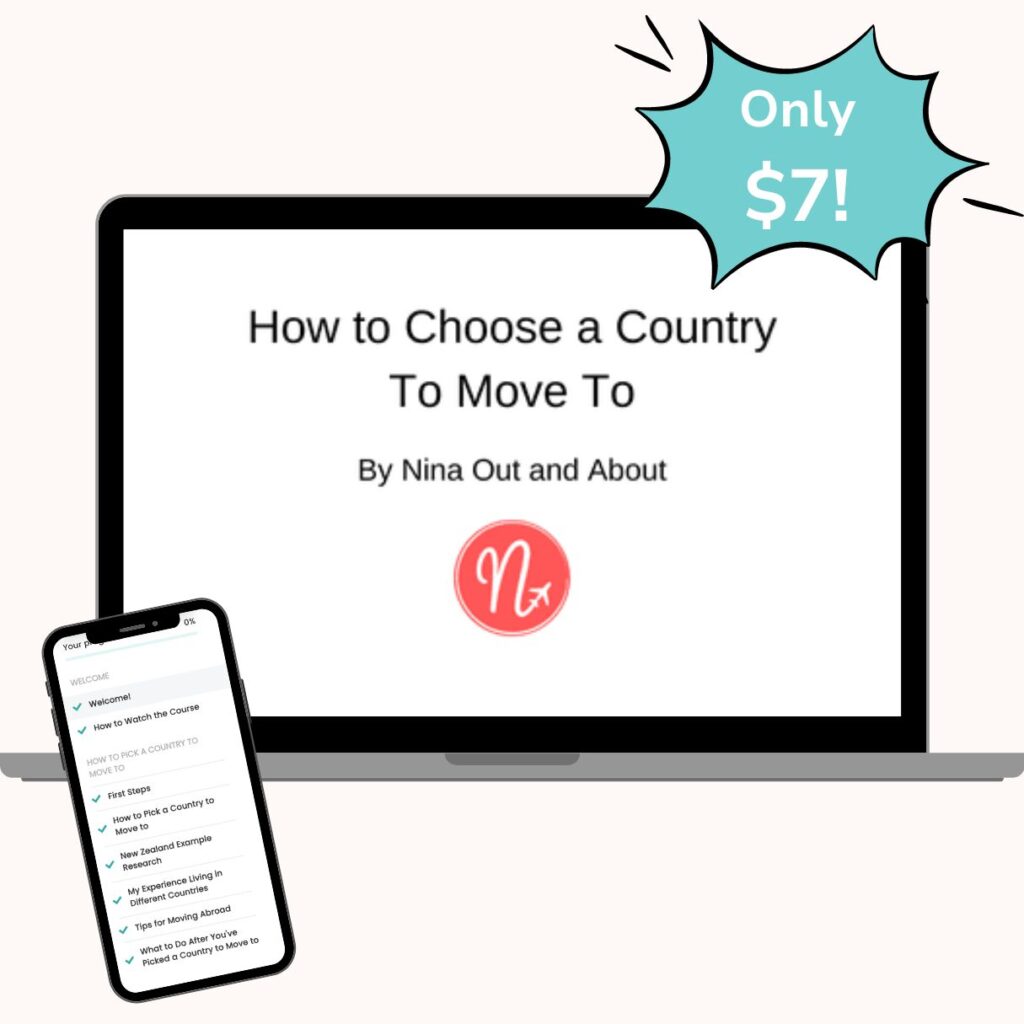
It depends – picking a country to live in is hard. That’s why I developed this $7 course to share all of the steps I’ve taken when deciding to move to 20+ different countries, and how I handle homesickness when I get there.
Ultimately, making the choice of where to move is going to be hard. But the hardest thing is deciding to move abroad at all!
💼 How do I get a job as an expat?
You can find work abroad via local job boards or temp agencies. My favourite way to work is remotely, so I always look for jobs on FlexJobs.com when I live abroad. They hire for 100% remote roles only.
If you’re looking to teach English abroad, Premier TEFL has the best online course to get you great work!
💰 How do I open a bank account abroad?
Wise.com offers free global accounts, and the cheapest money transfers. Since it can be a headache to open bank accounts in different countries (it took me 2 months in the UK!), Wise.com is a great solution.
I actually use it as my primary bank now worldwide due to the multi-currency debit card. (Read more)
👯♀️ How do you make friends abroad?
Meetup.com – Meet likeminded people who share a similar hobby with Meetup! It’s free to join, but some activities may cost money, like if you go to a cafe and get a coffee.
🙀 I don’t speak the language. Can I still live abroad?
Learn languages in no time with iTalki! Moving abroad is an opportunity to learn the language. You don’t need to know it before you leave home.
💻 Do I need a VPN?
Yes! – VPNs allow you to access more of the internet. From US Netflix in the UK to social media sites banned in Asia. It’s a really helpful and cheap thing to ensure your online activities aren’t restricted.
🧳 What’s the best luggage for living abroad?
This is my favourite luggage set for long term travel. You can read more about my review of types of suitcases for travel here.
🏡 How do I tell my friends and family I want to live abroad?
Take this $7 course and learn the exact script I used to tell my family I was moving abroad … and then when I did it again. I even include tips for prepping your family, and for how to handle family who aren’t supportive.
✈️ What’s the best site to buy cheap flights?
To find cheap flights, I recommend Skyscanner. (Read more)
🏨 What’s the best site to find cheap hotels?
To find cheap hotels, I recommend Booking.com. (Read more)
Or stay for free with Trusted Housesitters!
🚗 What’s the best site to rent cars abroad?
To find cheap rental cars, I recommend Discover Cars.
🚗 What’s the best site to find tours?
To find epic tours, I recommend Viator.