Nina Out and About contains affiliate links and is a member of the Amazon Services LLC Associates Program. If you make a purchase using one of these Amazon links, I may receive compensation at no extra cost to you. See my Disclosure Policy for more information.
27 Pros and Cons of Living in Vermont in 2024
Are you wondering about the pros and cons of living in Vermont? The Green Mountain State is one of the smallest and least populated US states, which adds to its attraction for many.
As with anywhere, there are benefits and drawbacks.
Vermont offers a laid-back lifestyle and low crime rates, but on the other hand, it has a high cost of living and long winters.
Before you take the leap and move to Vermont, consider these 27 pros and cons to help you decide if it’s right for you.
Let’s start with one of the best things about life in Vermont for a digital nomad or someone just looking for a more rural lifestyle.
Planning to move to Vermont? Check this platform for affordable flights.

1. Pro: Lots of Space
Vermont is the perfect fit if you want to leave the crowded city behind for a more rural lifestyle.
The state is one of the least populated (apart from Wyoming), with less than 650,000 people spread over 24,905 km (15,475 miles).
Burlington is the largest city, with just over 42,000 residents.
With a population density of only 68 people per square mile, living in Vermont offers you plenty of privacy and space.
2. Con: Cost of living
Although Vermont offers an excellent quality of life, it comes at a price.
The overall cost of living in Vermont is 17% higher than the national average.
A single person must earn a minimum of $37,044 USD a year to cover rent, utilities, food, and transport.
Before deciding, consider your budget to see if you can live comfortably.
3. Pro: Stunning Scenery
One of the upsides of living in Vermont is the stunning scenery.
Vermont is a beautiful state with breathtaking views, from the Green Mountains and forests to Lake Champlain.
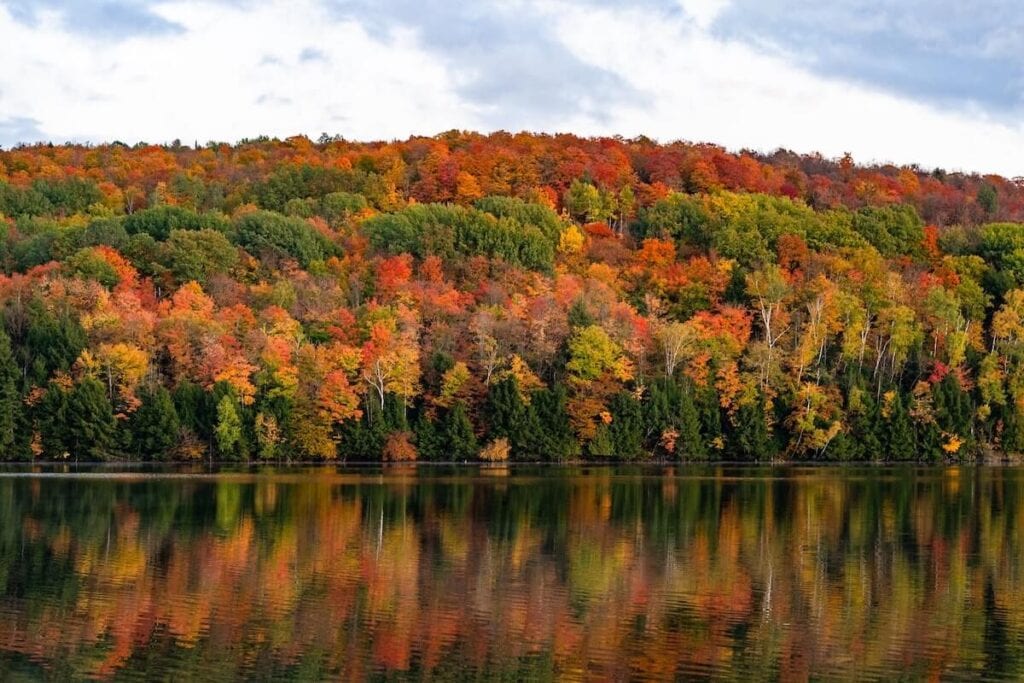
The fall is scenic, and people travel here from all over to see how the foliage changes to orange and yellow.
4. Con: Winters Can Be Brutal
Vermont is well known for its long, snowy winters.
Vermonters will tell you that life can be challenging during cold winter.
Temperatures routinely drop below freezing, with January being the coldest month, with an average high and low of -2/-12°C (28–10°F).
Vermont gets an average of 89.25 inches of snow a year. More than any other state.
If this fills you with dread, then moving to Vermont is not for you.
5. Pro: Endless Snow Sports Opportunities
If you’re a snow sports enthusiast, living here will be a breeze.
It’s also a great way to connect with the locals.
The locals make the most of it by skiing, snowboarding, ice skating, sledding, snowshoeing, and more.
Vermont has 22 ski resorts, including Stowe and Killington.
6. Con: Seasonal Affective Disorder (SAD)
Between 9-10% of Vermonters suffer from SAD.
This is something to consider, especially as Vermont is ranked one of the top states for seasonal depression.
Having said that, the locals are prepared for it and deal with it by spending time outdoors and joining in activities like skiing and snowshoeing.
7. Pro: Vermont has 4 seasons
Vermont is the place to be if you want to live somewhere with four distinct seasons.
Winter generally lasts from December to March, but you might see snow in the spring from April to May.
Average temperatures in spring range from a high of 13–20℃ (55-68℉) to lows of 0–6℃ (32-43℉).
Vermont summers are mild and pleasant, lasting from June to August, with the hottest month being July.
The maximum summer temperatures average 25–38℃ (77-100℉), so it doesn’t get too uncomfortable and sticky, unlike other states.
Fall is from September to November, bringing beautiful fall foliage and leaf peepers.
Temperatures in the fall begin to decline from an average of 17℃ (63℉) in September to as low as -1℃ (30℉) in November.
8. Con: Mud Season
Living in Vermont means preparing for the unofficial 5th season, the mud season.
Mud season is just what it sounds like, a wet, muddy mess caused by melting snow and ice after a long winter. It usually begins in late March and finishes at the beginning of June.
Mud season brings difficulty, as there are more dirt roads than paved ones. The dirt roads turn muddy and slippery from melting snow, leaving many vehicles stuck.
Everyone finds a way to work together and get through the mud season.
9. Pro: Farmers’ Market Paradise
Self-sustainability is a huge part of life in Vermont, and living off the land has turned into a business for many locals.
There are 85 farmers’ markets across rural areas and cities, selling all sorts of amazing fresh produce.
It’s a great way to support local farmers and get organic food that hasn’t been processed or shipped from far away.
10: Con: Public Transportation
You’ll need a car if you plan to live in a rural area and commute into a city, as bus routes are scarce.
Public transportation in cities such as Burlington is fairly decent and can get you from city to city.
Most locals still prefer to use a car. It makes getting around much easier than having to rely on a timetable.
You’ll need a car in Vermont. Use this platform to find affordable car rentals!
11. Pro: Low Crime Rate
No place is crime-free, but it’s a big part of the decision when you’re looking to move somewhere new.
Vermont has the 3rd lowest violent crime rate and the 5th lowest property crime rate in America.
In 2022, Vermont saw a 16% decrease in violent crime and was one of only 15 states to see a decline.
Vermont also has fewer car thefts and burglaries than most other states.
When looking at the pros and cons of living in Vermont, feeling safe is one of the major advantages of living here.
12: Con: Housing Costs Are Going Through The Roof
Vermont house prices have risen lately, making affordable housing harder to find.
The median home value is $385,815 USD.
Although this varies depending on what area you buy in, which usually boils down to what you can afford.
Being able to afford a home could be a downside to moving to Vermont, but having a well-paid job could solve that problem.

13: Pro: Quality healthcare
Vermont has an excellent healthcare system, ranking 6th for overall healthcare and 4th for affordability and access to healthcare.
It is also consistently ranked as one of the top 5 healthiest states.
Access to high-quality healthcare is one of the best reasons to live in Vermont.
Get a quote from Safety Wing today to make sure you have access to great healthcare while you’re looking for a job with benefits.
14: Con: Feeling Isolated
Moving to Vermont from a more populated or busy area can make some feel isolated and lonely.
With less than 650,000 people spread across the whole state, it can be hard to meet new people and make friends at first.
But if you’re looking for a quieter life, then the Vermont way of life is perfect for you.
Want to meet new faces in Vermont? Join Meetups today!
15: Pro: Clean Air and Limited Pollution
The Green Mountain State is known for its clean air.
The air quality in Vermont is among the cleanest in the country, with minimal particle pollution and ozone levels.
This benefits people with asthma and allergies, as it decreases symptoms.
Regarding the pros and cons of living in Vermont, this one tips the scales in favor of making the move.
16: Con: Internet and Cell Service Have Poor Coverage
You’ll have a more reliable cell service and internet connection if you live in one of the cities or towns in Vermont.
Not so much in the more rural areas, as many still have DSL for their internet. Not good if you’re a digital nomad.
But things are progressing as the investment is ongoing to expand fiber-optic broadband into rural areas.
17: Pro: Solid Job Market
Despite being a small state, Vermont has a solid job market in the medical, educational, and tech industries.
Wages are good in Vermont, with the average salary at $52,000 USD.
The tourism industry employs a large number of people every year, but often on a seasonal basis.
Unemployment in the state hovers between 2.3 and 2.5%, which is lower than in other states.
18: Con: High Property Taxes
The average tax rate is 1.73%, making it the 5th-highest rate in the US.
The median property tax rate is $1,730 per USD 100,000 of the assessed home value, with an average of $4,697 USD annually.
But given where you’ll be living and the quality of life that Vermont offers, it’s still worth it.

19: Pro: Slower Way of Life
If you want a more relaxed and slower pace of life, then Vermont is the ideal place.
There is no big city stress, where everything is crammed, and everything has to be done yesterday.
You’ll go at your own pace and have time to enjoy nature at your doorstep. Not only will this benefit you physically, but it will also benefit you mentally.
20: Con: Utility Costs Are High
Utility bills are higher in Vermont. This is because homes have to be kept warm in the long, cold winters.
Here’s what you can expect to pay monthly, on average:
- Electricity: $110.79
- Gas: $110.43
- Cable & internet: $141
- Water: $18
Average Total: $380.22 USD
Although these figures are high, they won’t be as high in the summer.
21: Pro: People Are Friendly
Vermonters are said to be reserved until you get to know them.
It might seem that people keep to themselves, but that’s because they are so far from their nearest neighbor.
People here say hello to complete strangers when they walk past them. They help each other out in the mud season.
I think this sense of community is a definite plus and one you don’t find in bigger cities.
Want to get to know friendly people in Vermont? Join Meetups today!
22: Con: It Can Be Hard to Work in Your Chosen Career
Finding a job in Vermont could be challenging, especially if you’re looking for something outside the medical, educational, and tech industries.
UVM Medical Center and the University of Vermont are the biggest employers. The healthcare sector alone employs 13% of the workforce.
Looking for a job in Vermont? Check this search engine to find a suitable job for you.
23: Pro: Real Maple Syrup
Vermont produces real maple syrup (as does Canada) that tastes completely different from the ones you see on supermarket shelves.
It’s one of Vermont’s most iconic products and has been part of its history for centuries, so you must try it on your pancakes when in Vermont.
You can buy it at the local farmers’ markets and fairs.
24: Con: High Graduated Income Tax Rates
Vermont has a progressive state income tax with a top marginal rate of 8.75%, making it one of the highest in the US.
Income tax rates start at 3.35% and increase according to your earnings. Income over $204,000 USD would be taxed at 8.75%.
While this sounds like a lot, you won’t be taxed anywhere near that rate unless you earn $204,000 a year.
25: Pro: Ben & Jerry’s Ice Cream
Vermont is famous for its Ben & Jerry’s ice cream.
What is better than visiting their factory in Waterbury and seeing how the ice cream is made? Having a few samples!
26: Con: Air pollution in Winter
I know I said that Vermont has some of the cleanest air in the US, but this often doesn’t apply to the winter months.
Many rely on wood burning to keep their homes warm. While it might be a cost-effective way to heat a home, it releases harmful emissions that pollute the air.
27: Pro: Vermont Is The Most Environmentally-friendly State In The US
One advantage of living in Vermont is that it is officially the “greenest” state in the US.
This state’s forward-thinking approach to environmental protection includes banning single-use plastics and composting food scraps.
If you’re looking for an environmentally conscious way of life, this small state is the place to be.
Wrap-Up: Pros and Cons of Living in Vermont
Is Vermont a good place to live? When it comes to outdoor activities, Vermont is a top choice, especially during the winter.
Don’t forget about all the space and privacy you’ll have.
You’ll benefit from a more relaxed and casual way of life while surrounded by the most stunning scenery.
Ultimately, you’ll have to weigh the pros and cons of living in Vermont to see whether it’s right for you.
But before you move, I recommend having a well-paid job lined up and doing plenty of research so you know you’ve made the right decision.
Planning to move to Vermont? Check this post for affordable flights.
Living in the USA Guides
- Pros and Cons of Living in North Carolina
- Pros and Cons of Living in South Carolina
- Pros and Cons of Living in California
- Pros and Cons of Living in Washington State
- Pros and Cons of Living in Montana
- Pros and Cons of Living in Chicago
- Pros and Cons of Living in Dallas
- Pros and Cons of Living in New Orleans
- Pros and Cons of Living in Los Angeles
- Pros and Cons of Living in Las Vegas
- Pros and Cons of Living in Iowa
- Pros and Cons of Living in Vermont
- Pros and Cons of Living in Seattle
- Pros and Cons of Living in Maine
- Pros and Cons of Living in Phoenix, Arizona
- Pros and Cons of Living in the USA
- Pros and Cons of Living in Colorado
- Pros and Cons of Living in Texas
- Pros and Cons of Living in Alaska
- Best Pros and Cons of Living in Oregon
- Pros and Cons of Living in San Antonio
- Pros and Cons of Living in Colorado Springs
- Pros and Cons of Living in Nashville
- Pros and Cons of Living in Florida
- Living in Toronto vs. Chicago: Which is the Better City?
- Living in Puerto Rico Pros and Cons: Should You Move to PR?
- Pros and Cons of Living in Georgia, USA: Is Georgia a Good Place to Live?
- Pros and Cons of Living in Hawaii
- Pros And Cons Of Living In New York City
- Pros and Cons of Living in Arizona
Living Abroad Travel Planning Guide
🚑 Should I buy expat travel insurance?
100% YES! — With basic coverage averaging just $5-10 USD per day, enjoy peace of mind with a plan from Safety Wing!
🌎 What is the best country to live in as an expat?
It depends – the best country to live in as an expat will depend on your unique needs. I developed this free quiz to help you figure out where is right for you!
📍 How do I pick a country to live abroad?
It depends – picking a country to live in is hard. That’s why I developed this $7 course to share all of the steps I’ve taken when deciding to move to 20+ different countries, and how I handle homesickness when I get there.
Ultimately, making the choice of where to move is going to be hard. But the hardest thing is deciding to move abroad at all!
💼 How do I get a job as an expat?
You can find work abroad via local job boards or temp agencies. My favourite way to work is remotely, so I always look for jobs on FlexJobs.com when I live abroad. They hire for 100% remote roles only.
If you’re looking to teach English abroad, Premier TEFL has the best online course to get you great work!
💰 How do I open a bank account abroad?
Wise.com offers free global accounts, and the cheapest money transfers. Since it can be a headache to open bank accounts in different countries (it took me 2 months in the UK!), Wise.com is a great solution.
I actually use it as my primary bank now worldwide due to the multi-currency debit card. (Read more)
👯♀️ How do you make friends abroad?
Meetup.com – Meet likeminded people who share a similar hobby with Meetup! It’s free to join, but some activities may cost money, like if you go to a cafe and get a coffee.
🙀 I don’t speak the language. Can I still live abroad?
Learn languages in no time with iTalki! Moving abroad is an opportunity to learn the language. You don’t need to know it before you leave home.
💻 Do I need a VPN?
Yes! – VPNs allow you to access more of the internet. From US Netflix in the UK to social media sites banned in Asia. It’s a really helpful and cheap thing to ensure your online activities aren’t restricted.
🧳 What’s the best luggage for living abroad?
This is my favourite luggage set for long term travel. You can read more about my review of types of suitcases for travel here.
🏡 How do I tell my friends and family I want to live abroad?
Take this $7 course and learn the exact script I used to tell my family I was moving abroad … and then when I did it again. I even include tips for prepping your family, and for how to handle family who aren’t supportive.
✈️ What’s the best site to buy cheap flights?
To find cheap flights, I recommend Skyscanner. (Read more)
🏨 What’s the best site to find cheap hotels?
To find cheap hotels, I recommend Booking.com. (Read more)
Or stay for free with Trusted Housesitters!
🚗 What’s the best site to rent cars abroad?
To find cheap rental cars, I recommend Discover Cars.
🚗 What’s the best site to find tours?
To find epic tours, I recommend Viator.