Nina Out and About contains affiliate links and is a member of the Amazon Services LLC Associates Program. If you make a purchase using one of these Amazon links, I may receive compensation at no extra cost to you. See my Disclosure Policy for more information.
17 Pros and Cons of Living in New Orleans in 2024
Have you wondered about the pros and cons of living in New Orleans?
New Orleans is a city like nowhere else in the United States. Rich with history, music, culture and plenty of things to celebrate, the city is pulsing with life. New Orleans is great for families, singles, and people young and old.
Community is what makes New Orleans special.
Of course, all great cities have their challenges. Having recently visited New Orleans, I have been inspired to explore the pros and cons of living in New Orleans by highlighting the positives and negatives of this great city.
🛫 Wanna move to New Orleans? Check this platform to book affordable flights.
1. Pro: Cost of Living
Following Hurricane Katrina, there was a decline in population in New Orleans bringing rents and the cost of living down.
Overall, New Orleans is more affordable than most major American cities, however, that is starting to change slightly under today’s economic circumstances.
Keep in mind that living in a city is almost always more expensive than living in rural or suburban areas.
Rent, utilities, and groceries remain affordable and are all average or below average compared to national levels.
The median rent in New Orleans is $1174 USD. Rent in New Orleans is about 12.3% lower than the national median rent and ranks #76 out of America’s 100 largest cities. This means that in 76 cities nationwide, the median rent is more expensive than it is in New Orleans.
Utilities are 21% less expensive than the national average. Energy bills average about $134.79 USD a month.
Groceries are 2% lower than the national average. The average price of a gallon of milk is $2.18 USD while the average price of a hamburger is $4.66 USD.
2. Con: Gap Between the Rich and Poor
One thing is immediately evident in New Orleans – the gap between the rich and poor is staggering.
There are multi-million dollar neighbourhoods kilometers away from where people are living in tents under highway ramps.
The gap between the rich and the poor compounds the high crime rates in New Orleans.
Experts argue that social factors such as “covid, natural disasters, economy and price increases in things like food” as well as “high unemployment and poor education factor into the state’s poverty rate, which in turn could contribute to higher rates of murder in Louisiana.”
People living below the poverty line are not receiving an adequate share of resources in New Orleans.
To fix the deep-rooted inequality in the city, leaders need to look to making shelter, education, opportunity, food and healthcare available for underserved communities.
3. Pro: If you like food this is the place for you!
Foodies rejoice!
New Orleans is jam-packed with incredible culinary flavours. From Creole to Cajun, French to African, the New Orleans food scene is one of the most exciting aspects of the city.
With its proximity to the Gulf Coast, there is an endless supply of seafood which is a staple on most New Orleans menus.
Well-known for its many iconic dishes and drinks, some of which were developed or made famous in New Orleans, there is truly something for all palettes, even the pickiest.
Locals would definitely argue that the city’s identity is largely shaped by its food scene.
Can you even call yourself a New Orleans local without having a favourite joint to get your Pralines or Bananas Foster, Grilled Oysters and Jambalaya, Muffaletta and Po boy sandwiches? And don’t forget about the Etouffee!
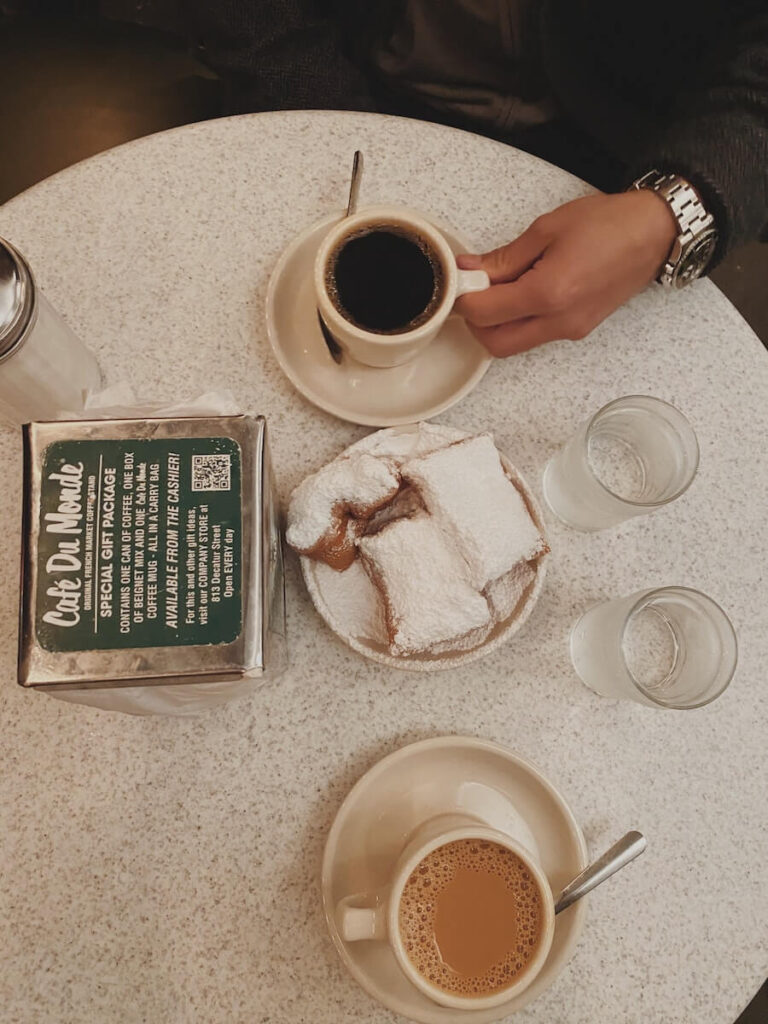
Locals and tourists alike cannot get enough of Café Du Monde for their fix of café au lait and beignets served warm in a paper bag filled with at least a cup of powdery white icing sugar. The original café is found on Decatur Street and has been in the beignet business since 1862.
Another well-loved New Orleans staple is gumbo, the official Louisiana state dish. Gumbo is a delicious blend of sausage, chicken or shellfish (and sometimes both), okra, stock, roux, celery, peppers, onions, and spices and is usually served with rice. Try it at Antoine’s, The Gumbo Shop or at Mr B’s Bistro – all in the French Quarter.
How do YOU feel about grits?
When I first found the courage to confront this traditional Southern staple, they were definitely not my cup of tea. However, when paired with cheese, it may just be one of my favourite comfort foods.
You can find grits on menus paired with everything from shrimp to eggs. There’s nothing in this city that can’t be paired with them!
4. Con: Crime and Gun Violence
You may be wondering, is New Orleans safe, especially for a woman?
My experience says yes!
I have rarely felt unsafe in New Orleans.
You need to have your wits about you and know where is generally safe and where is not, with the caveat that crime does and will occur in all neighbourhoods.
The state of Louisiana is an open carry state, meaning that it is legal to carry a firearm in the open, without a permit, as long as the bearer is legally allowed to own the gun and is at least 18 years of age.
Gun violence in New Orleans is a regular occurrence and in 2022, New Orleans experienced an uptick of crime with 887 people injured or killed by gun violence in the city alone in 2022. These statistics put New Orleans on track to be labelled America’s murder capital of the country.
Crime in general has risen to levels not seen since the ‘90s. However, I have not felt any less safe in New Orleans than I have in other major cities in the United States or abroad.
It is important to always remain vigilant wherever you are and has strategies in place to prevent being a victim of crime – i.e. walk in well-lit areas at night and in groups if possible, be aware of your surroundings etc.
5. Pro: The drinks are always flowing!
If it’s a stiff drink you are looking for, I have one word for you: bourbon.
This drink is popular by itself, mixed, or infused in tantalizing dishes.
A generous shot of bourbon accompanies my favourite breakfast of fluffy pancakes and smoked bacon at my favourite local diner, Café Fleur de Lis.
You can find bourbon in an array of foods from shrimp and grits to bourbon-infused pralines.
If straight shots of bourbon aren’t your speed, don’t worry! You can find drinks for every mood.
Grab a beer on Bourbon street and listen to some live music at Fat Catz. Sip wine and listen to jazz at one of New Orleans’ many famed jazz clubs. Order a handcrafted cocktail at the swanky Four Seasons Chandelier Bar.
You can hop from one bar to the next, with a drink in hand. It is legal to consume alcohol in public in New Orleans and many people do so!
🍹 Looking for a drinking buddy? Join MeetUp and make new friends in New Orleans!
6. Con: Weather
Temperatures on average remain above freezing all year round with average highs of 34° Celsius in July and average lows of 9 ° Celsius in January.
New Orleans’s summer heat is oppressive and muggy – definitely a factor to consider depending on how you feel about heat.
Winters can be dreary – wind, rain and clouds are common in the winter months.
Overall the climate is considered moderate when compared to states further north.
7. Pro: The city never needs an excuse to party!
Do you love a good party? New Orleans is the party capital of the USA.
Here, everything and anything is celebrated, most famously Mardi Gras.
Mardi Gras is a season, not just a day, with festivities spanning weeks leading up to “Fat Tuesday”.
New Orleans experiences an influx of tourists who flock to the city to take part in the action. Roughly 10 million people visit New Orleans during Mardi Gras season from early January through February/March, depending on when Fat Tuesday falls.
Mardi Gras spirit carries through the year, in nightlife, music and parades.
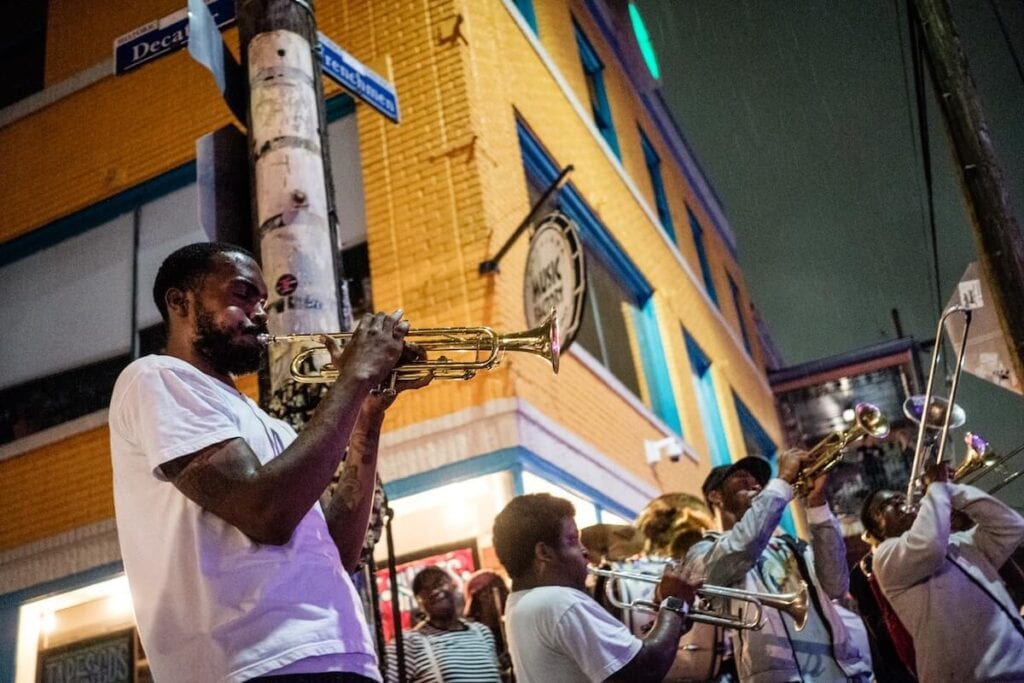
There is always something to do and celebrate in New Orleans. Bourbon Street, the famous thoroughfare in the French Quarter, is practically synonymous with partying.
Stroll from one bar to the next, taking in the French Quarter’s many musical offerings and boisterous nightlife.
If you love music, New Orleans is the place to be.
Being the birthplace of jazz is just one of the many bragging rights it holds title to.
There is always live music in Jackson Square in the daytime.
At night, Bourbon Street takes centre stage.
Music lovers in the city are sure to never miss the Jazz Festival that takes place every Spring.
The soundtrack of the city is arguably what puts New Orleans on the map.
📱 Wanna meet new people in New Orleans? Join Meetup today!
8. Con: Slow to rebuild and respond to natural disasters
Hurricane Katrina exposed a number of failures in New Orleans: one being the failure of the government’s adequate response to the disaster.
Another is the engineering failure of the city’s many levees to withstand the onslaught of water.
Perhaps the most significant failure was that of society which resulted in a disproportionately negative impact on poor and racialized communities in New Orleans.
The city is still rebuilding from the impacts of this storm.
The Ninth Ward, for example, was an area decimated when the levees failed and catastrophic flooding ensued. This is where you’ll remember seeing the intense rescues of people from their roofs.
This area has only recently experienced a resurgence of a new building and residents returning.
Sadly, the area remains at risk of repeated flooding and catastrophe as it lies below sea level (as does much of New Orleans) and within sight distance of said levees.
The constant threat of flooding is interestingly why most burials in New Orleans are above ground in mausoleums.
Katrina’s impacts can be seen and felt today. Population levels have not returned to their pre-Katrina levels, there are memorials to honour those who lost their lives to the storm, structures destroyed by Katrina have been left to decay, and interestingly, USPS mailboxes were never returned to the streets following Katrina.
9. Pro: The neighbourhoods here come with their own personality!
New Orleans has many neighbourhoods, each with its own vibe, demographics and unique characteristics that make it special.
The French Quarter is packed with history and edgy charm. The Garden District is charming, quiet and stately.
Marigny is vibrant and eclectic, while downtown has all the amenities and attractions of a modern city.
These are just a few, but there is a neighbourhood for every lifestyle in New Orleans.
📱 Join Meetup today and meet a bunch of different people!

10. Con: Natural Disasters
The city of New Orleans has collectively been through a lot. The infamous Hurricane Katrina shaped this city in many ways – physically and on an ominous level, as it always lingers in the mind of all who call New Orleans home. It’s hard to sum up the collective trauma experienced as a result of Hurricane Katrina.
Over a thousand people lost their lives in this storm. $108 billion in damage ensued.
New Orleans is low-lying and is surrounded by bodies of water including the Gulf of Mexico, the Mississippi river, Lake Pontchartrain and other estuaries and wetlands.
Hurricanes and storms are a fact of life between the months of June and November.
New Orleans is no stranger to hurricanes, having experienced in recent memory, at least five major storms – in a bizarre twist of fate all falling on (or around) August 29th.
The city is at risk of flooding and is slowly sinking. The climate of New Orleans could be considered a detractor, if not a risk, to living here.
11. Pro: History buffs will be in their glories!
If you love history, New Orleans is one of the oldest cities in the United States.
It was founded on the banks of the Mississippi River by France in the early 1700s (natives lived in New Orleans long before this date).
It is a place where cultures converge and blend beautifully together, New Orleans has strong French, Spanish, Creole and Cajun influences. Spain controlled New Orleans following the French until it reverted back to French rule.
Shortly after this, France sold New Orleans to the United States in the so-called Louisiana Purchase.
New Orleans is an important port in the Gulf of Mexico, being so close to both the Gulf and the Mississippi river. It is easy to see why this land was settled and played an important role in American history.
In both the Civil War and the War of 1812, important battles occurred with New Orleans serving as the theatre.
As slavery was abolished, many free black people who were enslaved in the South found solace in New Orleans.
The history can be seen and felt walking through the storied streets. There are many plaques around the city explaining the historical significance of the location.
If you want to delve further into New Orleans’s history, you can hop on one of the many tours available in the city. One of my favourites is the Oak Alley Plantation tour which is a short journey outside the city.
12. Con: Crumbling Infrastructure
The downside of old architecture is decaying infrastructure.
New Orleans is riddled with uneven sidewalks, large holes, and uneven surfaces, making faceplants on the streets somewhat inevitable. The streets are full of potholes and the highways are clearly old and crumbling. Traffic is heavy and at peak times at a standstill.
A recent report found that New Orleans residents spent “an average of $685 a year in vehicle operating costs due to driving on rough roads, and an additional $1,312 due to lost time and wasted fuel while sitting in traffic congestion. The report classified 30% of the city’s roads as in poor condition.”
The streets are congested because public transit is not great.
However, kudos to the brand-new state-of-the-art airport that is a delight to travel through and likely why there is no budget for pothole repairs.

13. Pro: The People
One of the best things about New Orleans is the people.
The people in New Orleans are resilient, and there is a real sense that people look out for one another.
There is a spirit of moving onwards and upwards while remaining loyal to their roots.
The people are charming and warm. Southern hospitality is alive and well in New Orleans!
Most locals (the good ones at least) you’ll meet and then feel like you’re their long-lost friend.
In the South, things are laid back and New Orleans is no exception to this.
So, if you are looking for a fast pace of life, New Orleans might not be the place for you!
📱Wanna meet new people in New Orleans? Join Meetup today!
14. Con: Jobs in New Orleans
The economy in New Orleans has largely recovered since Hurricane Katrina but there is still a lack of high-skilled salaried careers.
Most jobs in New Orleans revolve around the booming tourism industry.
As we know, 2020 brought tourism to a standstill and resulted in the loss of many service industry jobs. These are making a steady return as is tourism in the city.
The jobs that are available and need to be filled are service industry jobs. These jobs tend to be low paying and limited in growth opportunities.
There are some opportunities in New Orleans but young graduates and other professionals may find it more lucrative to relocate to other cities for employment.
👩🏻💻 Looking for a job in New Orleans? Check this search engine and land your dream job.

15. Pro: Architecture Galore!
The architecture in New Orleans is beautiful and unique with French, Spanish, and Creole influences.
The architecture is stately with large columned porches and balconies common across all types of buildings.
Four of the most quintessential New Orleans building styles include ‘Shotgun’ Houses, Creole Townhouses, American Cottages, and Queen Anne Style mansions.
Shotgun houses are named for the centre hallway design that lines up with both the front and back doors. If a bullet was fired through the front door it would emerge through the back. These are a hallmark of the city and your chance to live in a uniquely New Orleans-style house.
Creole Townhouses are likely what you associate New Orleans with. They are commonly found in the French Quarter with commercial space on the bottom floor and two levels of living space above. Living here means you are surrounded by history and hustle and bustle.
American Cottages are littered across neighbourhoods in New Orleans. They are charming single-family-style homes. If you love houses with large front porches, this is the place for you!
The grand Queen Anne Style mansions are a sight to behold, most commonly seen in the Garden District. These are the most expensive on the list but are sure to wow your houseguests!
The St. Louis Cathedral deserves recognition for its beauty. Perhaps the epicentre of New Orleans, standing proudly over Jackson Square, it dates back to 1727 and has survived fires, wars and hurricanes.
16. Con: The Sales Tax is Sky High
Sales tax in the city of New Orleans is double what most Louisiana residents who reside out of the city pay.
Louisiana sales tax is 4.45%. Orleans Parish also levies a sales tax of 5%.
Meaning, you can expect to pay 9.45% sales tax in New Orleans.
And if the transaction takes place in the French Quarter neighbourhood of New Orleans, expect to add an additional 0.245% sales tax.
This makes day-to-day purchases more expensive – but is the price you have to pay to live in this great city.
17. Pro: Places of Higher Education
New Orleans is home to numerous post-secondary institutions. Tulane University, Loyola University, Xavier University and The University of New Orleans to name a few.
Tulane University is perhaps the most well-known of the group. It is a private university in New Orleans and is incredibly hard to get into with an acceptance rate of 10%. Tulane University’s tuition is $62,000 USD a year.
Loyola University is also a private university founded by the Jesuits of the Catholic order. It will cost you approximately $45,000 USD a year to attend Loyola.
Xavier University is unique because it is the only private Catholic HBCU (historically black college and university) in the country. Tuition is about $26,000 USD.
The University of New Orleans is a smaller public college in the city. Tuition is more affordable here, running in-state students at approximately $10,000 USD a year.
There is no shortage of places to attend university in New Orleans!
Conclusion: Pros and Cons of Living in New Orleans
I would recommend life in New Orleans to everybody!
New Orleans has its challenges, but there is so much to celebrate here. The quality of life in New Orleans is reasonable considering the low cost of living, city amenities like culture and cuisine, great neighbourhoods and slow pace of life.
The main disadvantages that prevent a higher quality of life in New Orleans are the threat of violence, poverty, the weather, higher sales tax, lack of high-paying jobs and crumbling infrastructure.
The pros definitely outweigh the cons of living in New Orleans, making it one of the most desirable places to both live and visit in the United States.
🛫 Wanna move to New Orleans? Check this platform for affordable flights.
Living in the USA Guides
- Pros and Cons of Living in North Carolina
- Pros and Cons of Living in South Carolina
- Pros and Cons of Living in California
- Pros and Cons of Living in Washington State
- Pros and Cons of Living in Montana
- Pros and Cons of Living in Chicago
- Pros and Cons of Living in Dallas
- Pros and Cons of Living in New Orleans
- Pros and Cons of Living in Los Angeles
- Pros and Cons of Living in Las Vegas
- Pros and Cons of Living in Iowa
- Pros and Cons of Living in Vermont
- Pros and Cons of Living in Seattle
- Pros and Cons of Living in Maine
- Pros and Cons of Living in Phoenix, Arizona
- Pros and Cons of Living in the USA
- Pros and Cons of Living in Colorado
- Pros and Cons of Living in Texas
- Pros and Cons of Living in Alaska
- Best Pros and Cons of Living in Oregon
- Pros and Cons of Living in San Antonio
- Pros and Cons of Living in Colorado Springs
- Pros and Cons of Living in Nashville
- Pros and Cons of Living in Florida
- Living in Toronto vs. Chicago: Which is the Better City?
- Living in Puerto Rico Pros and Cons: Should You Move to PR?
- Pros and Cons of Living in Georgia, USA: Is Georgia a Good Place to Live?
- Pros and Cons of Living in Hawaii
- Pros And Cons Of Living In New York City
- Pros and Cons of Living in Arizona
Living Abroad Travel Planning Guide
🚑 Should I buy expat travel insurance?
100% YES! — With basic coverage averaging just $5-10 USD per day, enjoy peace of mind with a plan from Safety Wing!
🌎 What is the best country to live in as an expat?
It depends – the best country to live in as an expat will depend on your unique needs. I developed this free quiz to help you figure out where is right for you!
📍 How do I pick a country to live abroad?
It depends – picking a country to live in is hard. That’s why I developed this $7 course to share all of the steps I’ve taken when deciding to move to 20+ different countries, and how I handle homesickness when I get there.
Ultimately, making the choice of where to move is going to be hard. But the hardest thing is deciding to move abroad at all!
💼 How do I get a job as an expat?
You can find work abroad via local job boards or temp agencies. My favourite way to work is remotely, so I always look for jobs on FlexJobs.com when I live abroad. They hire for 100% remote roles only.
If you’re looking to teach English abroad, Premier TEFL has the best online course to get you great work!
💰 How do I open a bank account abroad?
Wise.com offers free global accounts, and the cheapest money transfers. Since it can be a headache to open bank accounts in different countries (it took me 2 months in the UK!), Wise.com is a great solution.
I actually use it as my primary bank now worldwide due to the multi-currency debit card. (Read more)
👯♀️ How do you make friends abroad?
Meetup.com – Meet likeminded people who share a similar hobby with Meetup! It’s free to join, but some activities may cost money, like if you go to a cafe and get a coffee.
🙀 I don’t speak the language. Can I still live abroad?
Learn languages in no time with iTalki! Moving abroad is an opportunity to learn the language. You don’t need to know it before you leave home.
💻 Do I need a VPN?
Yes! – VPNs allow you to access more of the internet. From US Netflix in the UK to social media sites banned in Asia. It’s a really helpful and cheap thing to ensure your online activities aren’t restricted.
🧳 What’s the best luggage for living abroad?
This is my favourite luggage set for long term travel. You can read more about my review of types of suitcases for travel here.
🏡 How do I tell my friends and family I want to live abroad?
Take this $7 course and learn the exact script I used to tell my family I was moving abroad … and then when I did it again. I even include tips for prepping your family, and for how to handle family who aren’t supportive.
✈️ What’s the best site to buy cheap flights?
To find cheap flights, I recommend Skyscanner. (Read more)
🏨 What’s the best site to find cheap hotels?
To find cheap hotels, I recommend Booking.com. (Read more)
Or stay for free with Trusted Housesitters!
🚗 What’s the best site to rent cars abroad?
To find cheap rental cars, I recommend Discover Cars.
🚗 What’s the best site to find tours?
To find epic tours, I recommend Viator.