Nina Out and About contains affiliate links and is a member of the Amazon Services LLC Associates Program. If you make a purchase using one of these Amazon links, I may receive compensation at no extra cost to you. See my Disclosure Policy for more information.
Retiring In Ireland: Pros And Cons (From an Expat!)
If you’re anything like me, you probably wonder what it would be like to retire abroad, and Europe has always been the most appealing.
I’ve actually lived in 10 different European countries and traveled to a lot more, including Ireland. Also, I have a good friend who lives in Ireland right now, and she loves it!
It’s safe to say that Ireland is high on my wish list of countries where I’d want to live long-term.
It’s one of the only English-speaking EU countries post-Brexit, and the scenery is on another level. But it’s important to consider ALL the pros and cons before making the move. For instance, the weather could be better, and finding affordable housing can be a struggle.
So, let’s find out if retiring in Ireland is right for you!

1. Pro: Beautiful Nature And Peaceful Countryside
Ireland is nicknamed the Emerald Isle due to its endless rolling hills. The country is one of Europe’s best places to live, known for its lush green fields, rolling hills, and breathtaking cliffs.
I love hiking with my dog Theo, so easy access to nature is one of the crucial aspects I consider when choosing a place to settle.
Of course, plenty of expats choose to base in Dublin, but access to nature is one of the crucial aspects I consider when choosing a place to settle.
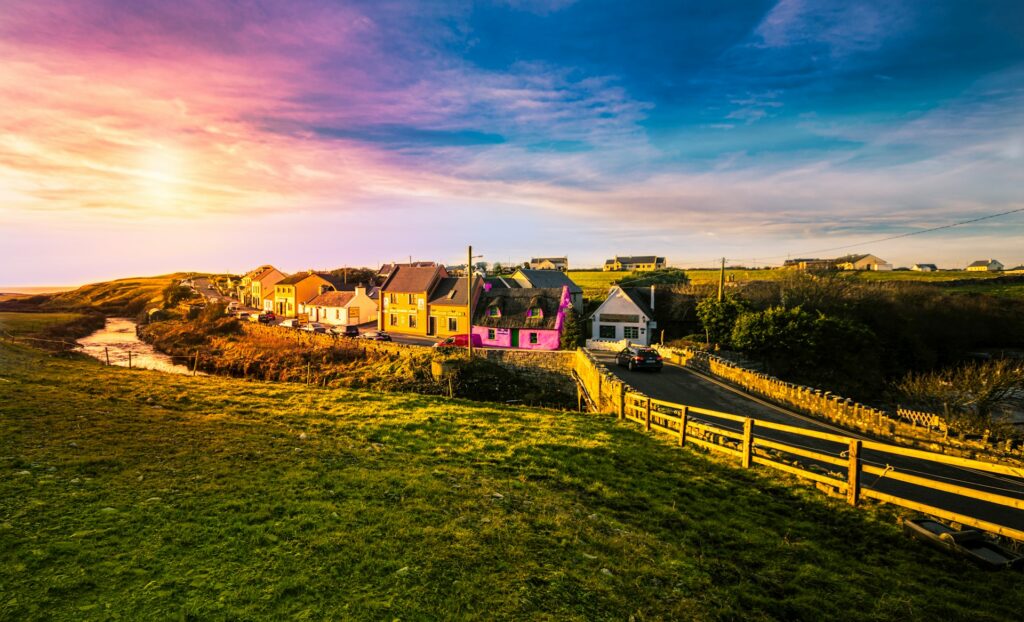
So, the Irish countryside is more appealing to me. That way, I can quickly go hiking with my dog, Theo. It’s also much less polluted than the cities and closer to iconic landmarks in Ireland like Giant’s Causeway and the Cliffs of Moher!
2. Con: Bad Weather
Ireland may be an island but don’t expect to pass the time soaking up the sun on the beach.
While nature in Ireland is lovely, the Irish weather is a big downside of living in Ireland.
The temperature in Ireland is moderate throughout the year – 45-65º (7-18ºC). It’s rarely too hot or cold, but it rains a lot, even in the summer. It’s rare to have a few days of clear skies in Ireland, which is one of the things locals complain about most.
It occasionally snows in winter, but you don’t have to worry about minus temperatures for months on end, like in certain parts of Canada during winter.
The nice part is that if you’re retired, you also have more freedom than most people to book plane tickets somewhere warmer when you need sun!
3. Pro: English-Speaking Country
I dabble in foreign languages, but a huge advantage of retiring in Ireland is that the official languages in Ireland are English and Irish (Gaeilge).
There is a slight accent, but the language barrier is basically non-existent for people from the U.S. and Canada.
In my experience, this is beneficial not only for streamlining administrative and medical visits but also for communication and connecting with the locals. It also makes setting up life in the country more manageable, from finding an apartment to opening a local bank account.
The language barrier is basically non-existent, as the official languages in Ireland are English and Irish (Gaeilge).
You’ll have no issues talking with vendors and quickly making friends with your neighbors.
4. Con: Slow Retirement Visa System
If you’re considering living in Ireland, you have to think about it apart from tourism. One of the downsides of retiring abroad is the complex visa procedures, and Ireland is no exception.
Retiring in Ireland involves a process of several steps. These include getting retirement permission, applying for an Irish visa, submitting the application, and final registration.
To be eligible for retirement permission in Ireland, you must also prove that you can support yourself financially by demonstrating you have the required funds per year for your desired stay.
You’ll need to get a certification from an Irish accountancy firm and provide a spreadsheet form clearly showing your income and monthly spending.
Only after all of that will they even let you apply for an Ireland retirement visa.
The average application processing time is about four months, not including gathering the documentation and preparing for the certification.
Then, as if that wasn’t enough, you’ll need to reapply every year. Furthermore, it never leads to Irish citizenship, regardless of how long you stay in the country.
5. Pro: No Residency-Based Restrictions To Buy Property
Those who want to make Ireland their home will be happy to know that there are no residency-based restrictions to buying property in Ireland!
Many countries don’t allow non-citizens to buy property, so I think it’s a big advantage for those with enough money to purchase a home.
Houses in the countryside are incredibly affordable, and you can find homes with a large garden for a fraction of the price of a small flat in New York or Los Angeles.
6. Con: Housing Crisis In Dublin
It may be easy to find affordable housing in the countryside, but the capital of Ireland has a major housing crisis, and it’s almost impossible to find a cheap place to live in Dublin.
The cost of living in Dublin is more than double the cost of living in other areas of the country! However, to some retirees, it’s worth it for the ease of getting around without a car, access to medical care, and an assortment of activities to pass the time.
Young people usually compromise by living with roommates, but that’s not very comfortable for retirement.
If you’re not inclined to pay the price for the comfort of living in Dublin, the countryside is an affordable option!
7. Pro: Friendly Locals
When moving abroad, most people look forward to integrating into their new local community, and you’ll find it surprisingly easy in Ireland.
The Irish are known as one of the most friendly nations, and without a language barrier, you’ll be making friends in no time. This is particularly easy in the countryside where it seems like everyone in town knows each other.
Despite my best efforts, I’ve lived abroad in non-English-speaking countries and found it challenging to connect with locals. You won’t have that problem in Ireland!
Also, many people leave the big city and move to the countryside as they get older, so it will be easy to find friends your age.

8. Con: Less Diversity Outside Of Dublin
Dublin is by far the most diverse city in Ireland. There are people from all different nationalities and backgrounds living here, and you’ll also have endless choices for food and entertainment.
However, that vibrant diversity doesn’t extend much outside the big cities.
Most villages are very homogenous societies, and if you’re part of a minority, you might feel a bit intimidated. If you grew up in a large city, you might also find the countryside social scene underwhelming and quiet.
Eating out and entertainment options are pretty limited, too. It’s often just a local pub or two in each town.
9. Pro: Moderate And Progressive Politics
It’s tough to escape political tension in today’s world, which is why the politics of a country are an essential aspect to consider before moving somewhere now.
I tend to lean more progressive, making Ireland a desirable country. Unlike several European countries, Irish politics is relatively moderate and progressive. Ireland legalized same-sex marriage and abortion in the late 2010s.
Civil rights, freedom of speech, and transgender rights are also protected!
10. Con: Expensive Health Insurance For Retirees
Health care in Ireland is quite different than in the USA, so it’s good to consider your options before moving, especially if you have some chronic illness.
Ireland has both public and private healthcare.
Public healthcare is free for all Irish citizens, but locals often complain of long wait lists when the public healthcare system is overwhelmed. Sometimes, people have to wait several months for non-life-threatening issues.
So, most locals opt for private healthcare, which can be quite expensive. If you retire in Ireland, it’s a good idea to get private health insurance to cover your expenses.

11. Pro: Good Quality Food And Clean Air
Ireland has high standards for food production, so healthy food is affordable and easily accessible. You can get fresh produce from the farmers, and the country is known for high-quality dairy and meat.
You’ll also notice right away that the air is fresh and clean throughout Ireland, even if you’re far from the ocean.
Assuming you appreciate nature as much as I do, you’ll find this much more pleasant than the concrete jungles in the U.S. and other Western European cities.
12. Con: Lacking Public Transport In The Countryside
For those living outside of the city in Ireland, one major downside is that there’s very limited public transportation, which means you’ll have to buy a car.
This can make some people feel isolated, but it also means you’ll have to buy a car. Living without a car in the countryside makes everyday tasks a bit more complicated, and you’re really far from social events.
Renting a car in Ireland obviously isn’t a long-term option, so you’ll either need to buy a car or live close to Dublin. Driving also gets more challenging as you get older. You might not feel as comfortable driving at 75 as you do at 65.

13. Pro: Cheap European Travel
I don’t know about you, but I never plan to stop traveling, and European cities never seem to get old. That’s one of the reasons Ireland is a great place to retire.
It’s part of the EU, a very short flight from other European countries. Because you’re retired, you can also travel off-season for a fraction of summer prices.
During the gloomy Irish winters, you’ll be able to jump on a plane to the south of Spain, Greece, or Portugal for less than $50 each way.
14. Con: High Cost Of Living
Another important thing to consider before retiring and living abroad is the cost.
The quality of life in Ireland is high, but it’s definitely not a cheap place to live, and the cost of living increases every year.
So, if you dream of retiring in luxury, Ireland might not be the best option.
You’ll also have to prove that you can comfortably finance your life in the country before even getting retirement permission in Ireland.

15. Pro: Community Festivals And Free Entertainment
While life in Ireland is generally expensive, you don’t have to spend much to have a good time. There are many free natural wonders to explore and quite a few free entertainment options!
All around the country, local authorities often organize community festivals, fairs, and markets.
This also makes it a lot easier to build a social circle.
If you’re retired, you’ll have time to attend all the community events, which are excellent places to meet locals and make friends. You can even volunteer!
16. Con: Lack Of Variety In Stores
If you’re used to massive supermarkets in the USA and a picky diet, you might be a little disappointed by small Irish shops.
While there are plenty of supermarkets in Dublin and other larger cities, most towns only have one or two local stores with limited stocks. Say goodbye to endless rows of bacon, chips, and milk. Most of the time, you’ll only get to choose between one or two brands.
Also, there are very few retailers outside of the city. So, you’ll need to visit Cork, Limerick, or Dublin for clothes shopping.
17. Pro: It’s Very Safe
The final pro – and possibly the most important to me – is that Ireland is an incredibly safe country, especially compared to living in the USA.
Ireland often ranks as one of the safest countries in the world, with generally low crime rates.
Contrary to living in the USA, violent crimes and murders are very rare, and the country is relatively free of conflict and terrorism. Also, there are strict restrictions on gun ownership, and most people won’t even consider applying for a firearms certificate.
Sure, there are areas of Dublin that people will tell you are considered unsafe, but it’s highly unlikely you will find yourself in a bad situation if you use basic common sense.
Summary: Pros and Cons of Retiring In Ireland
Living in Ireland has many advantages, which is why so many people think about retiring here, but there are also some disadvantages that are important to consider before making the move.
If you retire in Ireland, you’ll never run out of ways to use your free time. Most retirees spend their days exploring the beautiful nature around Ireland, socializing at local events, and taking city breaks to other European countries.
There are no residency-based restrictions for buying either, and countryside housing is quite affordable!
But you should be aware that it’s not the quickest process to obtain a visa, and if you plan on moving to Dublin, the cost of living is very high!
If you feel nervous about moving, check out these expert tips for how to overcome the challenges of moving to a new country!
Read more about living in Europe:
- Pros and Cons of Living in Italy as an Expat
- Living in Portugal Pros and Cons
- Pros and Cons of Living in France
- What It’s Like Living in Ireland
- Pros and Cons of Living in Germany
- Pros and Cons of Living in Berlin as an Expat
- Best Places to Live in Europe for Expats
- Pros and Cons of Living in the Czech Republic for Expats
- Pros and Cons of Living in Amsterdam
- Living in Prague: The Complete Expat Guide
- Pros and Cons of Living in Turkey
- Pros and Cons of Living in Austria
- Pros and Cons of Living in Sweden
- Pros and Cons of Living in Switzerland
- Pros and Cons of Living in Denmark
- Living in Serbia Pros and Cons
- Living in Portugal Pros and Cons
- Pros and Cons of Living in the UK: Should You Move to England?
- Pros and Cons of Living in Scotland as a Foreigner
- Pros and Cons of Living in Oxford, England from an Expat
- Pros and Cons of Living in Spain
Living Abroad Travel Planning Guide
🚑 Should I buy expat travel insurance?
100% YES! — With basic coverage averaging just $5-10 USD per day, enjoy peace of mind with a plan from Safety Wing!
🌎 What is the best country to live in as an expat?
It depends – the best country to live in as an expat will depend on your unique needs. I developed this free quiz to help you figure out where is right for you!
📍 How do I pick a country to live abroad?
It depends – picking a country to live in is hard. That’s why I developed this $7 course to share all of the steps I’ve taken when deciding to move to 20+ different countries, and how I handle homesickness when I get there.
Ultimately, making the choice of where to move is going to be hard. But the hardest thing is deciding to move abroad at all!
💼 How do I get a job as an expat?
You can find work abroad via local job boards or temp agencies. My favourite way to work is remotely, so I always look for jobs on FlexJobs.com when I live abroad. They hire for 100% remote roles only.
If you’re looking to teach English abroad, Premier TEFL has the best online course to get you great work!
💰 How do I open a bank account abroad?
Wise.com offers free global accounts, and the cheapest money transfers. Since it can be a headache to open bank accounts in different countries (it took me 2 months in the UK!), Wise.com is a great solution.
I actually use it as my primary bank now worldwide due to the multi-currency debit card. (Read more)
👯♀️ How do you make friends abroad?
Meetup.com – Meet likeminded people who share a similar hobby with Meetup! It’s free to join, but some activities may cost money, like if you go to a cafe and get a coffee.
🙀 I don’t speak the language. Can I still live abroad?
Learn languages in no time with iTalki! Moving abroad is an opportunity to learn the language. You don’t need to know it before you leave home.
💻 Do I need a VPN?
Yes! – VPNs allow you to access more of the internet. From US Netflix in the UK to social media sites banned in Asia. It’s a really helpful and cheap thing to ensure your online activities aren’t restricted.
🧳 What’s the best luggage for living abroad?
This is my favourite luggage set for long term travel. You can read more about my review of types of suitcases for travel here.
🏡 How do I tell my friends and family I want to live abroad?
Take this $7 course and learn the exact script I used to tell my family I was moving abroad … and then when I did it again. I even include tips for prepping your family, and for how to handle family who aren’t supportive.
✈️ What’s the best site to buy cheap flights?
To find cheap flights, I recommend Skyscanner. (Read more)
🏨 What’s the best site to find cheap hotels?
To find cheap hotels, I recommend Booking.com. (Read more)
Or stay for free with Trusted Housesitters!
🚗 What’s the best site to rent cars abroad?
To find cheap rental cars, I recommend Discover Cars.
🚗 What’s the best site to find tours?
To find epic tours, I recommend Viator.